




































































































































Description
Power reliability remains one of the most critical yet underestimated challenges facing modern broadband operators. While network infrastructure continues to advance with faster speeds and broader coverage, the subscriber-side equipment that delivers these services—routers, ONTs, modems, and gateways—remains vulnerable to power interruptions that can instantly sever connectivity. For Internet Service Providers (ISPs) deploying fiber-to-the-home (FTTH) networks or managing large customer bases, selecting the right Mini DC UPS backup power solution requires careful evaluation beyond simple price comparison. Understanding what to verify before purchase can mean the difference between a successful deployment and a costly field service nightmare.
Understanding the Real Current Draw of Target Devices
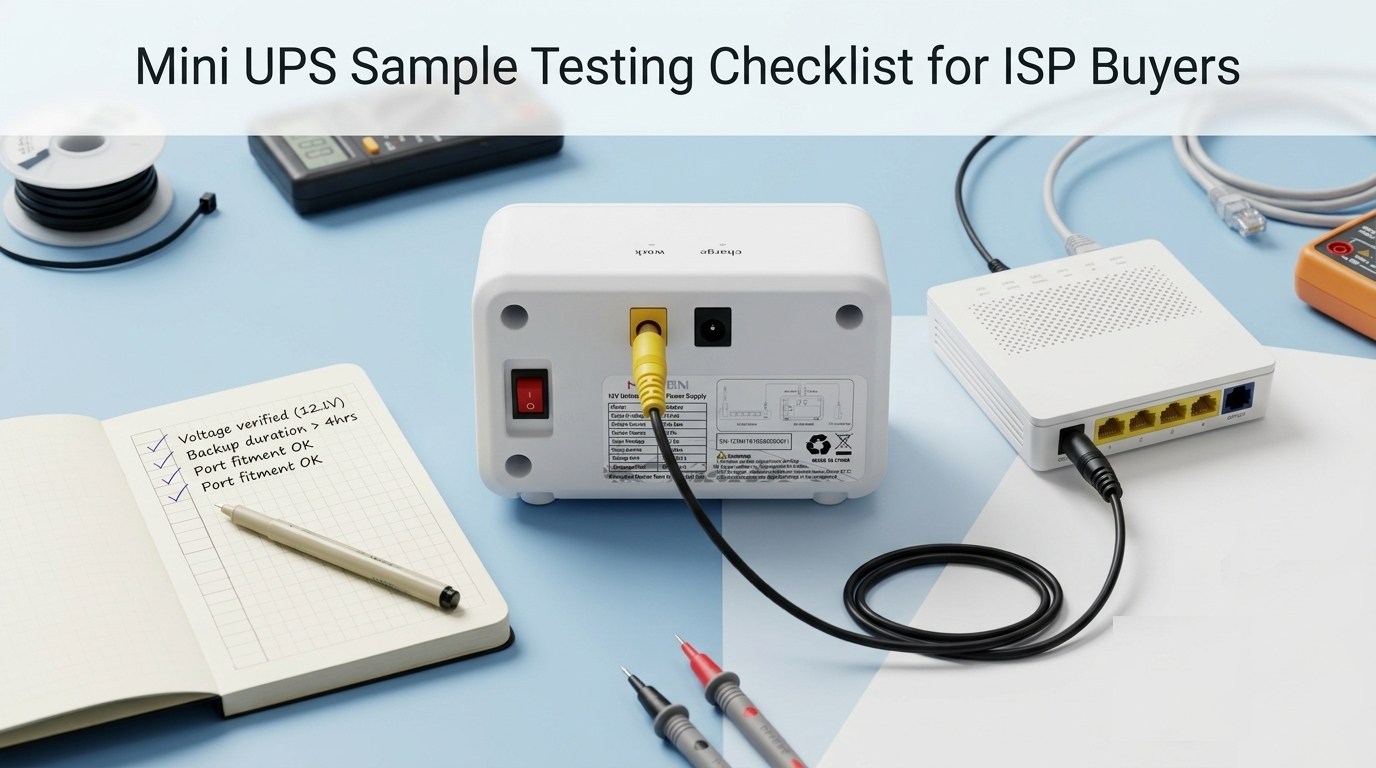
The single most common mistake broadband operators make when selecting Mini UPS units is relying solely on the power adapter label to determine backup requirements. A router adapter labeled "12V 2A" does not necessarily mean the device consistently draws 2 amperes during operation. Real-world current consumption varies significantly based on device activity, wireless transmission load, connected Ethernet ports, and startup surge behavior.
Before committing to any router backup UPS or ONT backup power solution, operators should measure actual working current under typical operating conditions. This includes monitoring current during device boot-up, when all Ethernet ports are active, during peak WiFi usage, and under firmware update processes. Startup surge current can momentarily spike to 150-200% of normal operating levels, and if the selected UPS cannot handle this peak demand, the device may fail to start or restart unexpectedly during power transitions.
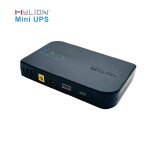
MYLION, a specialized provider of Mini DC UPS and telecom BBU solutions for global B2B customers, emphasizes application matching based on real device behavior rather than adapter specifications alone. Their engineering team supports customers in evaluating actual voltage, current, startup surge, and runtime requirements before model confirmation—helping avoid the common pitfall of under-specifying backup capacity.
Matching Voltage, Connector Type, and Cable Configuration
Voltage compatibility extends beyond the nominal 12V designation. Some network devices require precise voltage regulation within a narrow tolerance range, while others can operate across a wider input spectrum. Operators must confirm whether their target equipment requires strict 12V ±5% regulation or can tolerate wider variations, as this affects UPS design and battery management system configuration.
Connector compatibility represents another frequent deployment obstacle. Even within 12V applications, barrel connector sizes vary—common specifications include 5.5mm × 2.1mm, 5.5mm × 2.5mm, and other proprietary formats. Operators deploying thousands of units cannot afford connector mismatches that require field adapters or cable modifications.
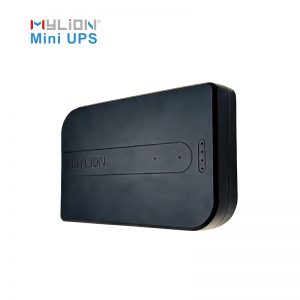
For gateway backup battery and CPE backup power deployments, MYLION provides connector and cable matching services as part of their project-based support. Their product lines, including the MU68, MU26, and MU48 standard 12V series, support customization for connector type, cable length, and output configuration based on specific device requirements—addressing a critical need for mass deployment consistency.
Calculating Required Backup Runtime
Theoretical backup time calculations often fail to account for real-world variables. A simple formula dividing battery capacity by device current provides only a rough estimate. Actual runtime depends on battery discharge characteristics, conversion efficiency losses, BMS protection thresholds, operating temperature, battery age, and whether the device maintains constant load throughout the backup period.
Operators should define clear backup time objectives based on typical outage duration in their service areas. In regions with frequent brief interruptions lasting 15-30 minutes, a compact UPS with moderate capacity may suffice. Areas experiencing extended outages of several hours require larger battery capacity, which affects unit size, weight, cost, and installation logistics.
For high-power gateway and advanced router applications, MYLION offers specialized models like the MU35 and MU65 high-current 12V BBU series, designed for devices that exceed the capacity of standard low-current Mini UPS units. These solutions support longer backup times through larger battery configurations while maintaining protection against overcharge, over-discharge, overcurrent, and short circuit conditions.
Evaluating Installation Environment and Physical Constraints
Customer premises installations present unique space and aesthetic constraints rarely encountered in controlled equipment room environments. Desktop-mounted UPS units may not fit within available space near fiber terminal boxes. Wall-mounted options require appropriate mounting surfaces and customer acceptance. Inline designs must accommodate specific cable routing paths without creating trip hazards or visual clutter.
Temperature extremes in attics, basements, or outdoor enclosures affect battery performance and lifespan. Operators deploying in hot climates must verify that selected UPS units include thermal management appropriate for ambient conditions. Similarly, high-humidity environments require adequate environmental protection to prevent corrosion and electrical failures.
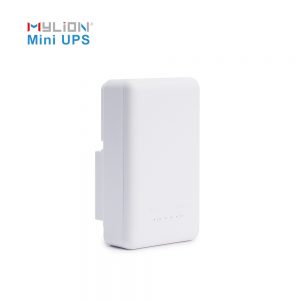
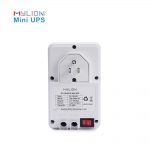
MYLION’s MUJ46 inline FTTH Mini UPS series addresses space-constrained installations by connecting directly between the power adapter and device, eliminating the need for separate mounting hardware. This design simplifies deployment for FTTH applications where clean installation and minimal visible equipment are priorities.
Confirming Battery Chemistry and Lifecycle Expectations
Standard lithium-ion and LiFePO4 (lithium iron phosphate) battery chemistries offer different trade-offs in energy density, cycle life, thermal stability, and safety characteristics. While lithium-ion batteries provide higher energy density in smaller packages, LiFePO4 alternatives deliver superior cycle life—often 2000-3000 cycles compared to 500-800 for standard lithium-ion—and enhanced thermal stability.
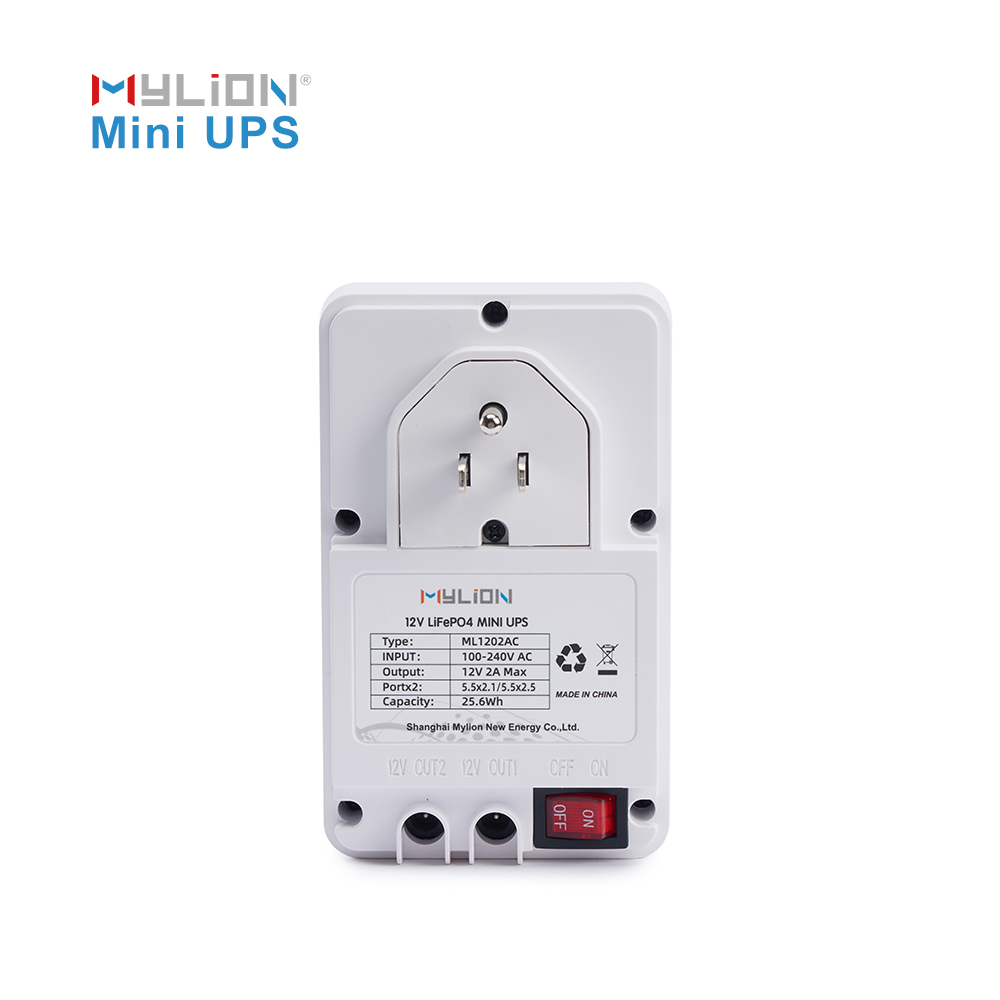
For deployments requiring long-term standby operation with occasional discharge cycles, LiFePO4 Mini UPS solutions like MYLION’s ML1202AC series may offer better total cost of ownership despite higher initial unit cost. The extended cycle life reduces replacement frequency, lowering long-term logistics and field service expenses.
Operators should also verify battery management system (BMS) protection features, including overcharge protection, over-discharge protection, overcurrent protection, short circuit protection, and cell balancing capabilities. Inadequate BMS design can lead to premature battery degradation or safety incidents during field deployment.
Addressing Certification, Documentation, and Compliance Requirements
International deployments and operator procurement processes often mandate specific certifications and technical documentation. Common requirements include CE marking for European markets, FCC compliance for North American deployments, RoHS certification for environmental compliance, and UN38.3 plus MSDS documentation for lithium battery transport.
Operators should confirm certification availability for specific product models and configurations before finalizing purchase decisions. Customized versions with modified connectors, cables, labels, or battery capacities may require recertification, extending project timelines and increasing costs.
MYLION supports international B2B project requirements with documentation including CE, FCC, RoHS, UN38.3, MSDS, product specifications, test reports, user manuals, and shipping-related lithium battery documents, depending on specific model and project configuration. For telecom and ISP projects, they provide safety, transport, labeling, packaging, and technical documentation required for sample testing, pilot projects, and mass deployment preparation.
Planning for Future Device Evolution
Broadband equipment evolves rapidly, with newer gateway and router models adopting USB-C Power Delivery (PD) input instead of traditional DC barrel connectors. Operators planning multi-year deployments should consider whether their UPS investment can adapt to emerging device standards or whether they risk obsolescence within deployment lifecycles.
MYLION’s MUC85 USB-C PD Mini UPS series addresses this transition, providing backup power for next-generation devices using USB-C PD architecture. This product line helps operators prepare for the gradual shift away from traditional DC barrel power delivery without maintaining parallel backup power inventories.
For specialized applications requiring 24V or 48V input—such as certain wireless CPE devices, small communication terminals, and professional DC equipment—solutions like MYLION’s MU248 series provide higher-voltage DC backup options without requiring bulky AC UPS systems and their associated conversion losses.
Establishing Quality Control and Supply Chain Reliability
Large-scale deployments amplify the impact of quality inconsistencies. A single batch with inadequate BMS calibration, defective connectors, or substandard battery cells can generate hundreds of field service calls, eroding customer satisfaction and operational budgets. Operators must verify supplier quality control processes, including incoming material inspection, production process verification, functional testing protocols, and pre-shipment inspection procedures.
Long-term supply reliability matters equally. Operators deploying thousands of units over multi-year contracts need assurance that selected models will remain available with consistent specifications, not discontinued or modified mid-deployment. Supplier communication responsiveness, technical support availability, and OEM/ODM customization capabilities all factor into total project risk.
With over 13 years of experience in lithium battery packs and backup power solutions, MYLION applies incoming material control, production process inspection, functional testing, and 100% outgoing inspection before shipment. Their B2B focus on telecom, ISP, and broadband applications emphasizes stable product quality, repeatable production, traceable inspection, and reliable communication for long-term cooperation.
Making the Right Pre-Purchase Decision
Successful Mini UPS deployment for broadband operations requires systematic evaluation across technical compatibility, operational requirements, certification needs, and supply chain reliability. Operators who invest time in thorough pre-purchase assessment—measuring real device current, confirming connector compatibility, calculating realistic backup time, evaluating installation constraints, verifying certifications, and establishing supplier quality standards—position themselves for smooth deployment, reduced field service costs, and improved subscriber experience during power interruptions.
The complexity of modern backup power selection underscores why experienced suppliers like MYLION structure their approach around project-based matching rather than generic product sales. By supporting customers through requirement analysis, model selection, sample testing, technical confirmation, and customization for specific deployment scenarios, specialized providers help operators avoid costly mistakes that only become apparent after thousands of units have been deployed to customer premises.
For broadband operators navigating the critical decision of Mini UPS selection, the question is not simply which product to buy, but whether they have verified all the technical, operational, and logistical factors that determine deployment success or failure.