










































































































Description
Specifying a Perkins engine fixes one variable in a generator set and leaves the others open. The alternator, enclosure, cooling package, controller and exhaust arrangement are all packager decisions, and two sets built on the identical Perkins block can behave differently once installed. From a procurement perspective the useful question is what a supplier adds around the engine. MPMC POWERTECH CORP., established in 2008 and headquartered in Shanghai Pudong, publishes Perkins-powered containerised configurations and lists delivered projects across hospitals, oilfields and municipal infrastructure.
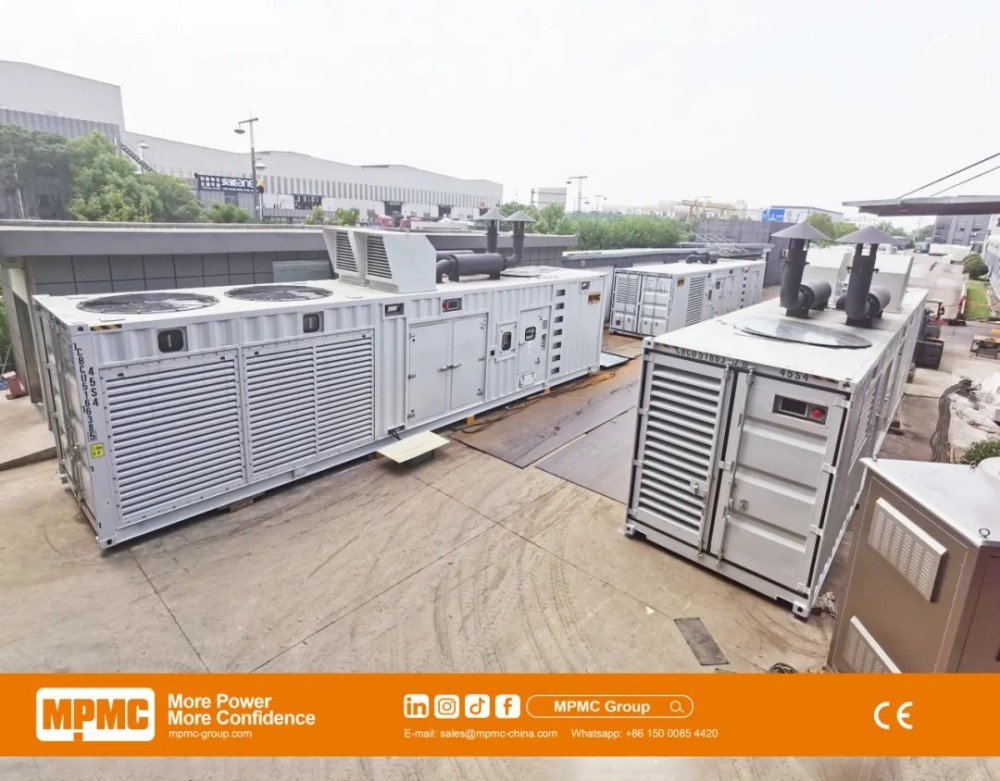
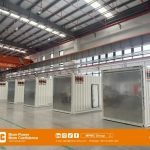
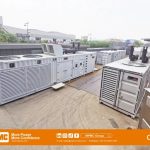
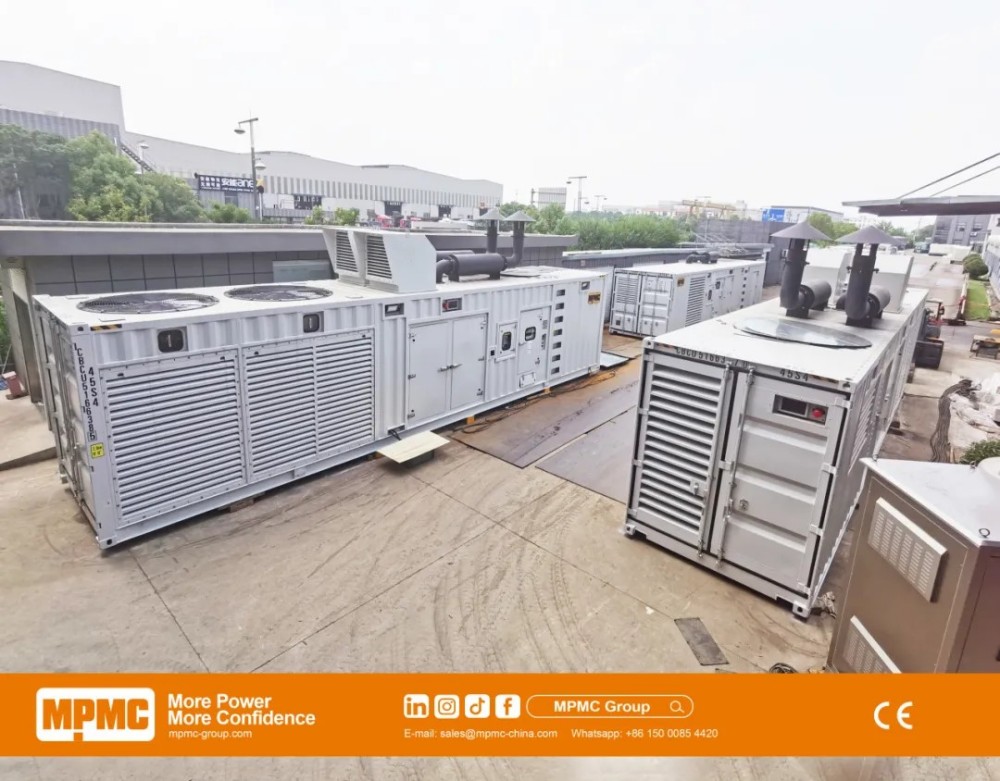
MPMC large containerised diesel generator sets — 6 MW, powered by Perkins
The Engine Brand and the Set Builder Are Two Decisions
A generator set is an assembly. The alternator, base frame, enclosure, radiator and airflow design, control panel, exhaust route and switchgear interface make up the rest, and the differences show up where a datasheet rarely goes: whether the radiator is sized for site ambient rather than test-bed ambient, whether the controller synchronises with switchgear already bought, and whether the connections suit the intended container layout.
Those are packager decisions and belong in the technical clarification round. MPMC lists Perkins across single-engine containerised units from 800 to 3,750 kVA and twin-engine units from 1,250 to 3,000 kVA, paired with Stamford or Leroy-Somer alternators, with availability varying by rating and region.
Perkins Configurations in MPMC’s Documented Projects
|
Installation |
Scale |
Published configuration |
|
Hospital critical load backup, New Zealand |
4 MW |
Perkins 4016-61TRG3 with Stamford S71D G41; 40HC super-silent at 85 dB(A) at 1 m at 100% load; DSE8610 with ABB 3200 A three-pole ACB; 2 × 3 kW block preheaters; internal 500 L tank with automatic filling |
|
Hospital critical power backup, New Zealand |
3.2 MW |
Perkins 4016-61TRG3 with Stamford S7L1D-G41 |
|
Hospital power backup, China |
3 MW |
Perkins 4012-46TAG2A with Leroy-Somer LSA 50.2 L8 312; AREP AVR with R450; DSE7320 with ABB air circuit breaker; 1,500 kVA × 2 units |
|
Oilfield lease, Iraq |
6.8 MW |
Perkins 4016TAG2A and 4016-61TRG3 with Leroy-Somer alternators; 50°C copper radiator; DSE7320 with ABB breaker |
|
Municipal electricity backup, Libya |
2.4 MW |
Perkins 4012-46TAG2A with Stamford S7L1D-C41 |
|
Mining integrated power plant, Australia |
14.7 MW |
Perkins 1104C-44TAG2 with Leroy-Somer LSA44.3 S5 permanent magnet alternators; 245 GSB hybrid stations |
A Middle East oilfield installation is also listed with a Perkins 4008TAG2A driving a Leroy-Somer TAL-A49-E at 800 kW in a 20GP container, plus two 1,800 kW high-voltage units on Perkins 4016-61TRG3 engines with Leroy-Somer LSA 53.2 XL11 alternators.
The Engine Choice Also Fixes the Service Route
MPMC’s published after-sales model relies on the global service networks of the engine and alternator brands, with MPMC’s own obligation covering manufacturing quality and parts replacement. Published warranty for the diesel genset series is 1 year or 1,000 operating hours, whichever comes first, while engine, alternator and controller coverage follows each original manufacturer’s terms.
The practical consequence is that engine brand selection should follow the destination country’s service map rather than head-office preference. A Perkins-powered set is the stronger choice where the nearest authorised Perkins service centre is within a workable response time; where it is not, the same packager’s Cummins or Baudouin configuration may serve the project better. Confirm the named centre before award rather than after.
Fuel and Emissions on the Perkins Platform
MPMC lists standard diesel to ASTM D975 Grade 2D across the range, with HVO to EN 15940 supported on selected models and higher biodiesel blends documented at project level. Euro V emission generator sets are listed among its Haimen manufacturing specialisations.
Fuel approval is model-specific and affects filtration, service intervals and material compatibility, so it should be confirmed in writing with the engine manufacturer as well as the packager for the fuel actually available at the destination.
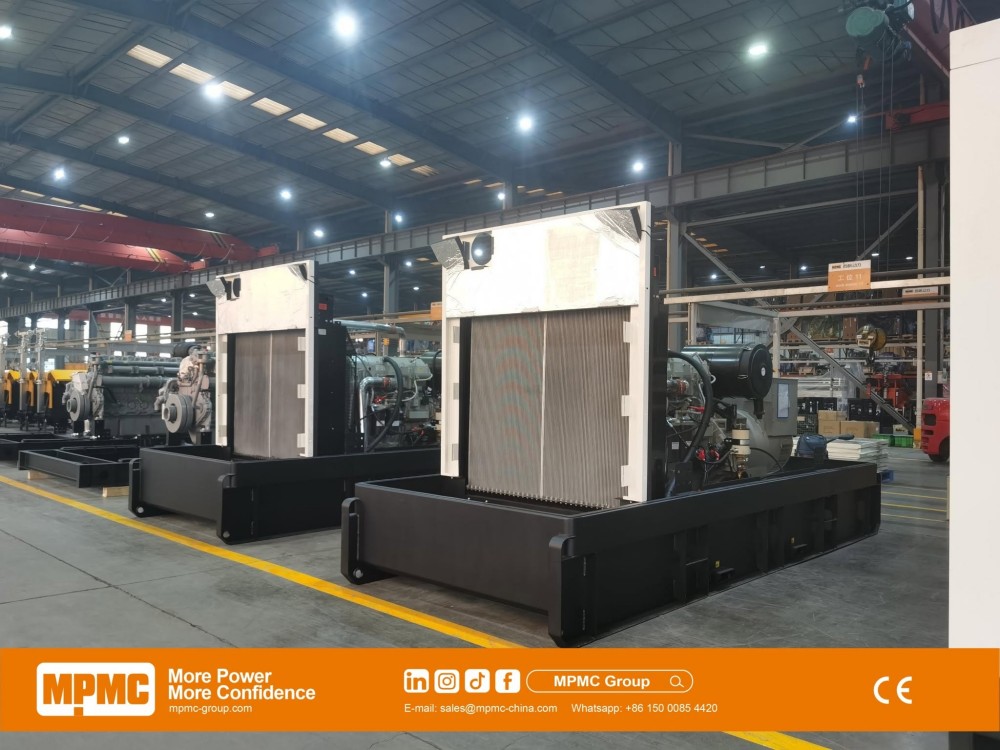
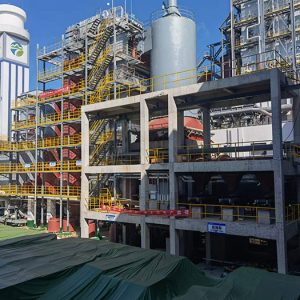
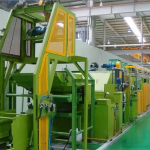
MPMC Haimen production base
Test Evidence That Should Travel With the Order
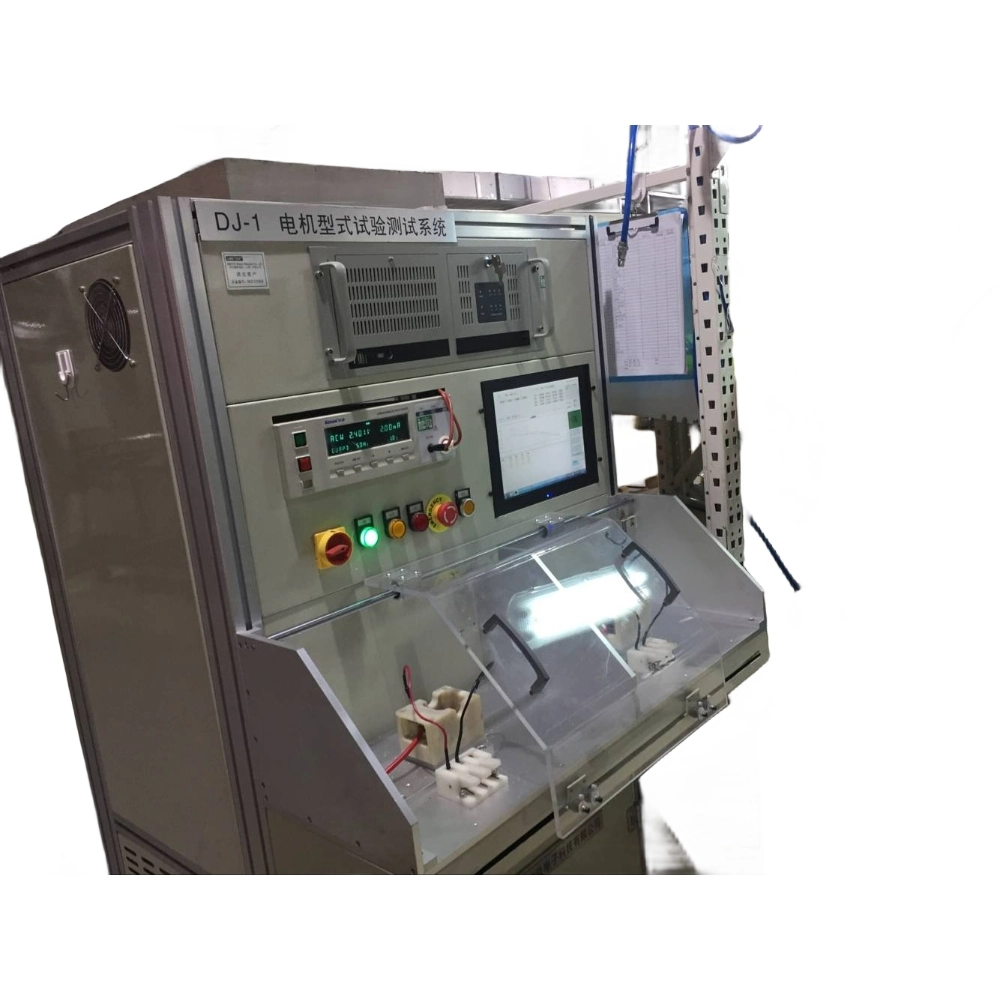
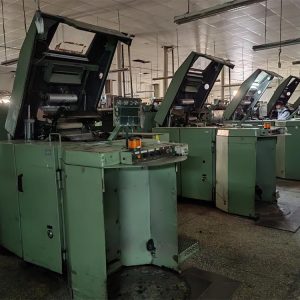
MPMC’s Haimen facility is described as a 22,000 m² workshop with a CNAS-accredited testing centre, where sets are load-tested at 0%, 25%, 50%, 75%, 100% and 110% before shipment across five power-section rooms including a constant-temperature room simulating 40°C and 50°C. Published steady-state parameters include frequency stability of ≤±0.25% at any constant load and rated voltage regulation of ±1%.
Read the accreditation precisely. A CNAS-accredited testing centre is a recognition of that facility, not a statement that every delivered unit carries an individual third-party certificate. The document that matters commercially is the factory acceptance test report for the serial number being shipped, together with the ISO 8528-5 performance class the set was tested against.
Where the Alternative Platform Is Worth Quoting
MPMC’s published engine list also includes Cummins, Baudouin, MTU, Scania, SME, Volvo, SDEC, Kubota and HD Hyundai Infracore. That flexibility is worth using deliberately rather than treating the engine brand as fixed at the outset.
Where the Perkins rating that suits the load sits awkwardly between frame sizes, the same packager can quote an alternative platform at the same enclosure and control specification. That keeps the comparison honest because only the engine changes, and it lets service coverage rather than preference decide the outcome.
Where a Perkins Set Sits in a Multi-Unit Scheme
Few projects at this scale buy a single set. Once two or more run together, the controller and breaker arrangement decides whether the installation behaves as a system or as several machines sharing a busbar. MPMC lists multi-unit parallel operation with load sharing through DSE or DEIF controllers and motorised circuit breakers, supporting N+X redundancy and master-standby rotation.
Sequencing matters commercially as well as technically, because two sets each running at 30% load consume more than one at 60% with the second held ready. The documented Chinese hospital installation shows the approach at 3 MW, listed as two 1,500 kVA Perkins-powered units in parallel rather than one large machine, which also allows one to be serviced while the other holds the load.
Questions to Put in the RFQ
• State the duty as standby, prime or continuous and ask which published rating applies.
• Ask for the derated output at site ambient temperature and altitude, with the calculation.
• Confirm which Perkins model and alternator pairing is offered.
• Ask whether an equivalent alternative platform is available at the same enclosure specification.
• Request the ISO 8528-5 performance class and a sample factory acceptance test report.
• Confirm the controller model and that it synchronises with the switchgear already specified.
• Identify the named authorised Perkins and alternator service centres for the project country.
• Obtain written fuel approval from Perkins for the fuel available at the destination.