


























































































































Description
The container is not packaging. It decides how the equipment arrives, what the site has to build, how much cooling the set can achieve and whether the unit can be moved when the project changes. From a procurement perspective those consequences matter more than the enclosure itself. MPMC POWERTECH CORP., established in 2008 and headquartered in Shanghai Pudong, publishes a containerised range from 800 to 3,750 kVA on single engines and lists island power station and industrial deliveries at multi-megawatt scale.
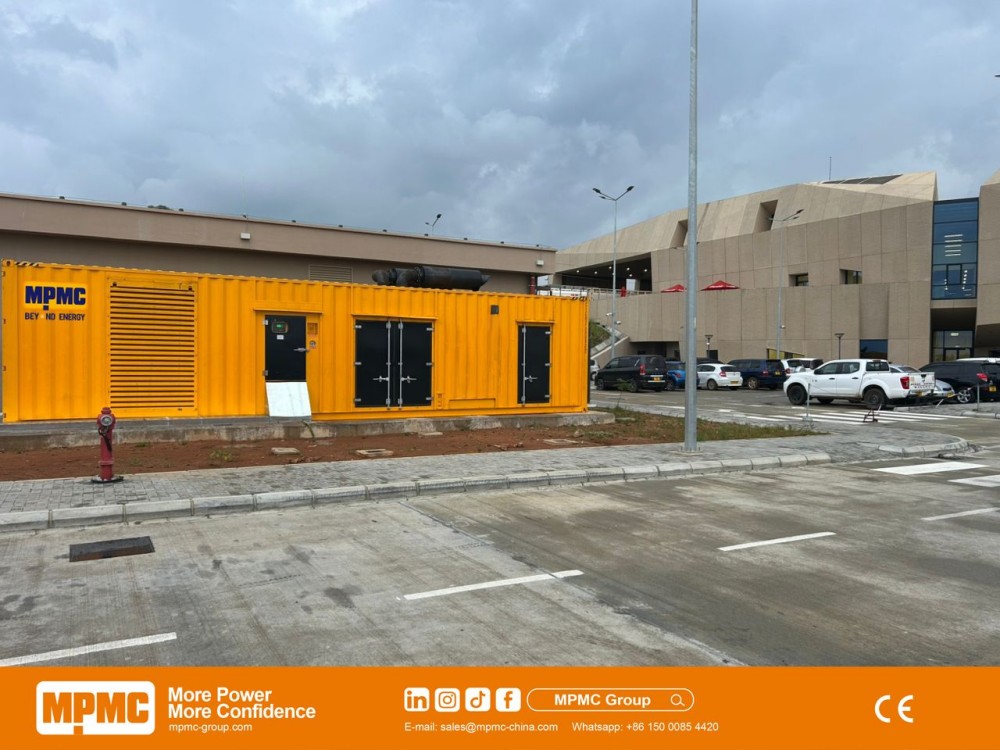
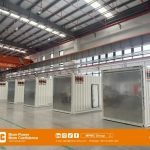
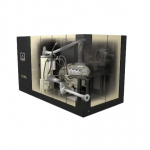
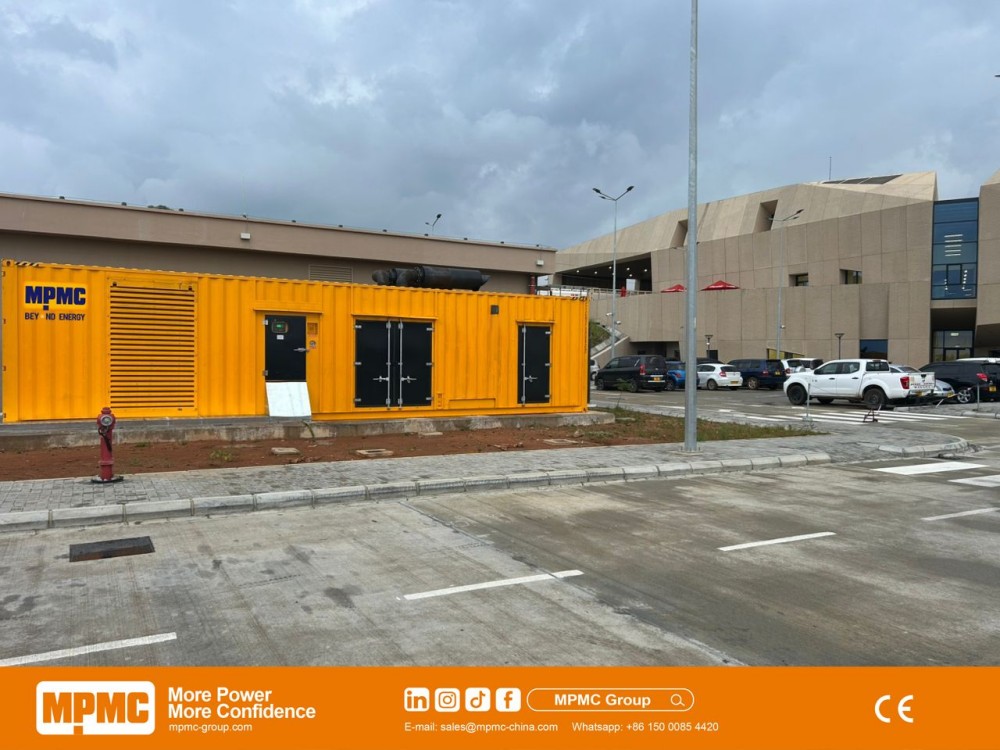
MPMC 1250 kVA containerised diesel generator set — Cummins KTA50-GS8
What the Container Removes From the Project
A containerised set arrives as a completed installation with its own enclosure, cooling, cabling and control, which removes a building, a concrete programme and a site electrical fit-out from the scope. On a power station or an industrial expansion that is usually the largest single saving, and it is a programme saving as much as a cost one.
MPMC lists 20GP and 40HC formats across the range, with ISO 12944 among applicable standards and anti-corrosion coating in C-3, C-4 and C-5 classes selected by application severity, supported by salt spray testing published at 500 to 700 hours twice per year and a stated minimum three-year outdoor rust resistance.
What the Container Constrains
Airflow through an enclosure is finite, so on a hot site the cooling package rather than the engine frequently sets the achievable output. MPMC lists a maximum ambient operating temperature of 50°C with copper high-temperature radiator options and altitude derating applied per engine model specification.
For a station running continuously the derating calculation should be requested for that duty at the site’s design ambient rather than at reference conditions, and the two figures are often far apart. Where the site is dusty, radiator fouling reduces effective cooling progressively, which makes the cleaning regime part of the availability plan rather than a housekeeping detail.
Choosing the Configuration Type
|
Configuration |
Published span |
Engines listed |
Where it fits |
|
Single engine |
800–3,750 kVA |
Cummins, Perkins, Baudouin, MTU, Scania, SME, Volvo, SDEC |
The main band for base-load blocks |
|
Twin engine |
1,250–3,000 kVA |
Baudouin, Scania, Perkins |
Redundancy within one footprint |
|
Four engine |
1,600 kVA |
Scania |
Modular load steps at moderate rating |
|
High-voltage output |
2,000 kVA and above |
Cummins QSK50-G17 |
Long cable runs across a station or plant |
The high-voltage option is the one most often overlooked at design stage. MPMC lists the MCLS2000H(S)-1 at 2,000 kVA prime with direct 10 to 11 kV output on a Leroy-Somer LSA 53.2 VL7 alternator. Removing a step-up transformer changes the single-line diagram, so the distribution study should precede model selection rather than follow it.
Rating Basis and Unit Count
Standby, prime and continuous ratings permit different duty, and the same physical set carries a lower figure under continuous service. A station or a continuously loaded industrial plant should specify the continuous rating in writing with the permitted load factor stated.
Unit count then decides fuel cost more than unit size does. A station built from a few large sets that each run lightly loaded burns more than one built from more units of appropriate size, sequenced so running machines stay well loaded. MPMC lists multi-unit parallel operation with load sharing through DSE or DEIF AGC controllers and motorised circuit breakers, supporting N+X redundancy and master-standby rotation.
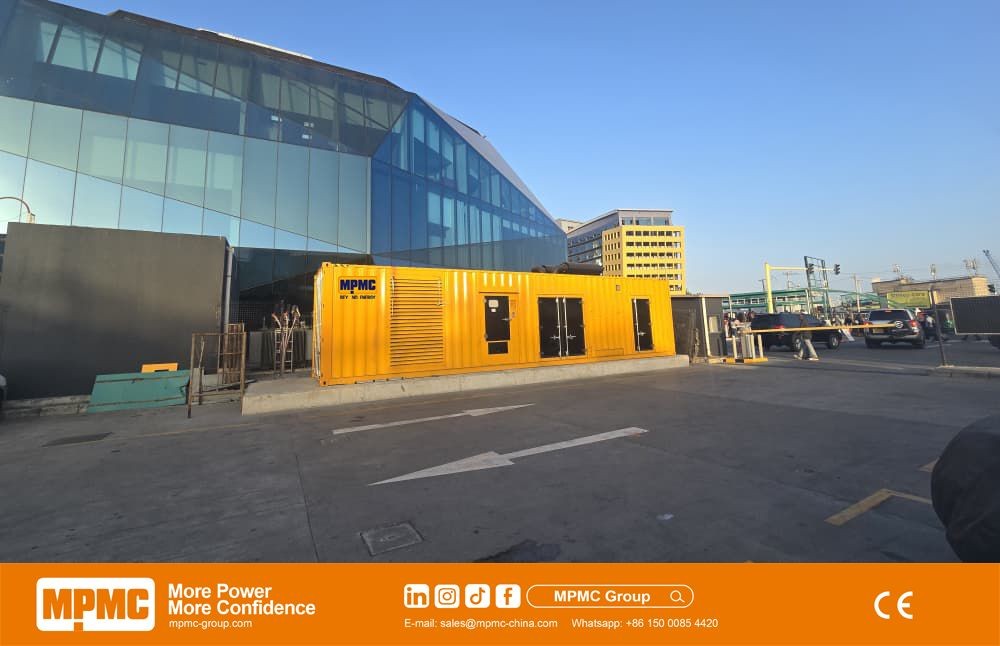
MPMC 1250 kVA containerised diesel generator set
Handling, Transport and Later Relocation
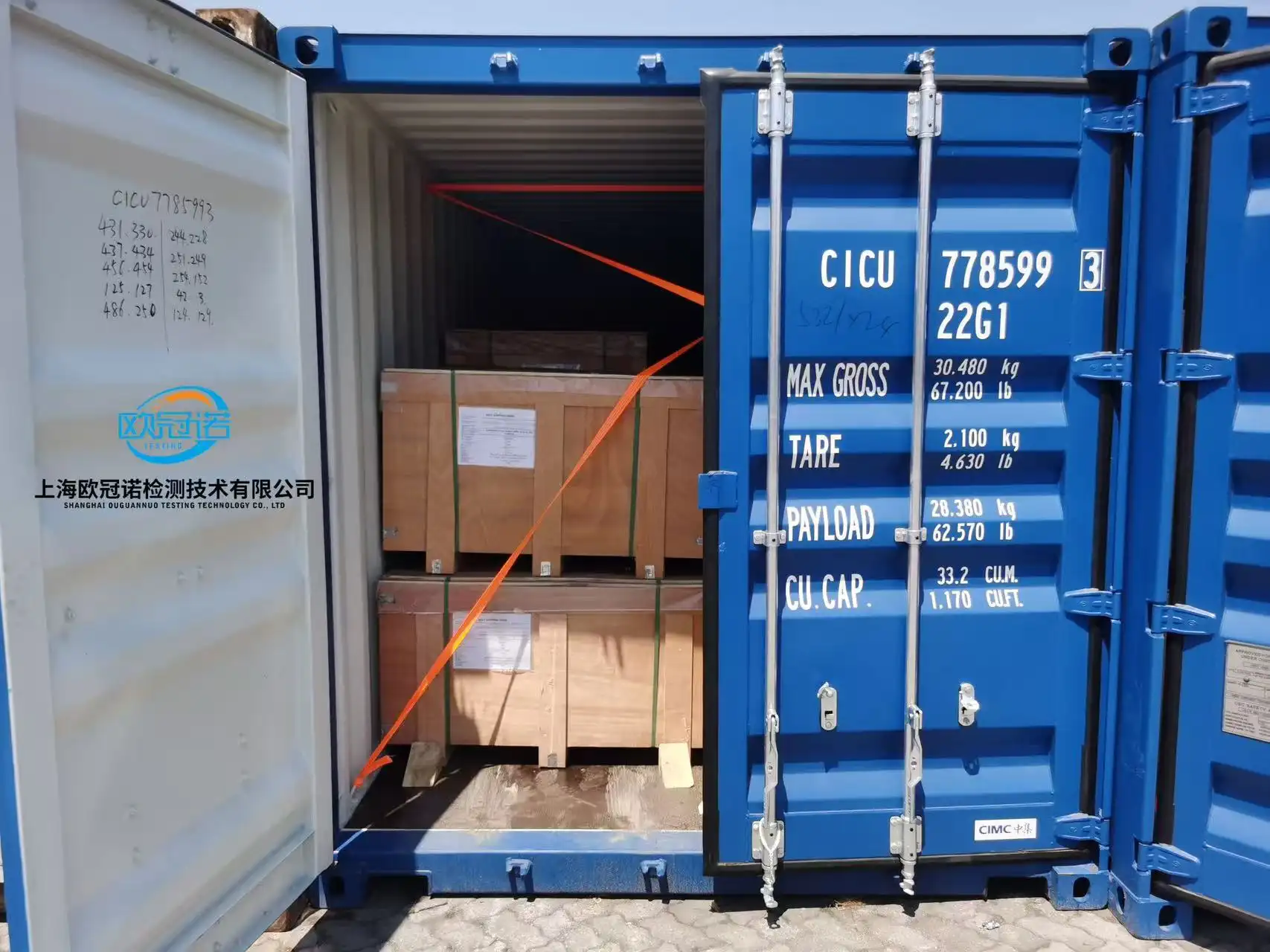
A containerised unit travels as standard freight, which is what makes it practical for island and remote industrial projects. The constraint to check early is what the destination can actually receive: port or site lifting capacity, road width between delivery point and position, and ground bearing where the unit will stand.
Where those limits bite, several smaller units are the workable answer even at a higher equipment cost per kilowatt. Industrial projects that expect to reconfigure also gain from the format, because a containerised set can be repositioned when a plant layout changes in a way a power house cannot.
Fuel Options Over the Asset’s Life
MPMC lists diesel to ASTM D975 Grade 2D as standard, with HVO to EN 15940 and B20 blends supported on selected Cummins models, and publishes a 21.6 MW Indonesian island power station running on B35 with Cummins KTA50-GS8 engines and Leroy-Somer LSA50.2 L8 alternators. Natural gas, methanol and biofuel platforms are also listed across the containerised range.
Fuel switching is not a drop-in change. It affects storage and handling, emissions permitting and the service regime, so any intended future switch belongs in the front-end study. Approval is model-specific and should be confirmed in writing with the engine manufacturer as well as the packager.
Documentation and Compliance Per Destination
MPMC’s published product compliance list includes CE, TUV, SGS, SABER for Saudi Arabia, BV, SONCAP, EAC and UL depending on model and market, with company certification including ISO 9001:2015, ISO 45001 and ISO 14001 and a CNAS-accredited testing centre at the Haimen facility.
Certificates apply by model and jurisdiction and do not transfer across a project’s variants. Where a station is delivered in phases across a multi-year programme, recording acceptable substitution criteria in the contract — equivalent rating, same controller family, same alternator brand — avoids renegotiating the specification each time a phase is released.
Selection Checks Before Ordering
• Require the continuous rating in writing where the duty is sustained, with the load factor stated.
• Request derated output at site ambient and altitude for the intended duty, with the calculation.
• Complete the distribution study before models are fixed, including any high-voltage option.
• Decide unit count and size against the load range rather than the peak alone.
• Specify the corrosion class against measured site exposure, with film thickness stated.
• Confirm lifting capacity, access width and ground bearing before unit size is fixed.
• Fix the parallel operation, rotation and breaker scheme at order stage.
• Confirm fuel approval in writing from the engine manufacturer for the intended fuel.